
• Link to Facebook
  • Link to Instagram
  • Link to Youtube
  • Link to Pinterest
Embracing Motherhood
  • Blogs
  • Resource Guide
  • TPT
  • YouTube
  • Etsy
  • Click to open the search input field Click to open the search input field Search
  • Menu Menu

Tag Archive for: best food for kids

Best Cupcake and Frosting Recipe for Kids

Desserts, General, Recipes

I have made a TON of cupcakes for my little ones and tried many many different variations, and this cupcake recipe is by far the best. I love using it because it works really well with the ingredients that I use regularly like freshly ground whole wheat flour, raw milk, and pastured eggs which are all great things for children to eat! The cream cheese buttercream frosting that I use for these cupcakes is low in sugar and full of flavor, which is also great for kids!

Cupcake Recipe

This recipe will make 24 regular sized cupcakes or 48 mini cupcakes.

Ingredients

  • 1 ½ Sticks Unsalted Butter (room temperature)
  • 1 ½ Cups Sugar
  • 2 Eggs (pastured are best)
  • 2 Teaspoons Vanilla Extract
  • 2 ½ Teaspoons Baking Powder (look for aluminum free)
  •  ¼ Teaspoon Real Salt
  • 2 ½ Cups Flour (I like mine freshly ground, but sprouted flour is the best for eliminating phytic acid if you can afford it.)
  • 1 ¼ Cups Milk (raw milk is best)

Directions

  1. Preheat the oven to 375° F.
  2. Beat the butter, sugar, and egg together until smooth.
  3. Add the vanilla, baking powder, salt, four, and milk. Mix until smooth and creamy.
    Julian Adding Flour to the Cupcakes

    Julian Adding Milk to the Cupcakes

    Julian Mixing Ingredients for the Cupcakes

    Julian Mixing Ingredients for the Cupcakes

  4. Pour into individual baking cups (Sometimes I use baking cups and other times I just spray the pan with some olive oil and go without.) until they are about two-thirds full. I usually like making one pan of regular sized cupcakes and one pan of mini cupcakes.

    Cupcake Batter Poured into Muffin Trays

    Cupcake Batter Poured into Muffin Trays

  5. Bake for 20 minutes or until golden brown.
Cupcakes Baked and Cooling

Cupcakes Baked and Cooling

Cupcakes and Mini Cupcakes

Cupcakes and Mini Cupcakes

Frosting Recipe

This will make enough to frost 24 regular sized cupcakes or 48 mini cupcakes. It’s the perfect consistency when at room temperature, but keep in mind that it will harden quite a bit when refrigerated.

Ingredients

  • 1 Stick Unsalted Butter (room temperature)
  • 1 8 oz Package Cream Cheese (room temperature)
  • 2 Cups Powdered Sugar (You could really even get away with only one cup, just taste it first.)
  • 2 Teaspoons Vanilla Extract
  • *1-2 Teaspoons Milk (wait until the end)
  • *Cocoa Powder, Red Food Coloring and Strawberry Extract (optional)

Directions

  1. Make sure butter and cream cheese are soft to the touch before you get started.
  2. Combine all of the ingredients and mix until smooth and creamy.
    Julian Mixing Ingredients for the Cupcakes

    Ophelia Making the Frosting

    Whipped Frosting

    Whipped Frosting

  3. If you want to thin out the frosting a bit, add one teaspoon of milk at a time until it is the desired consistency.
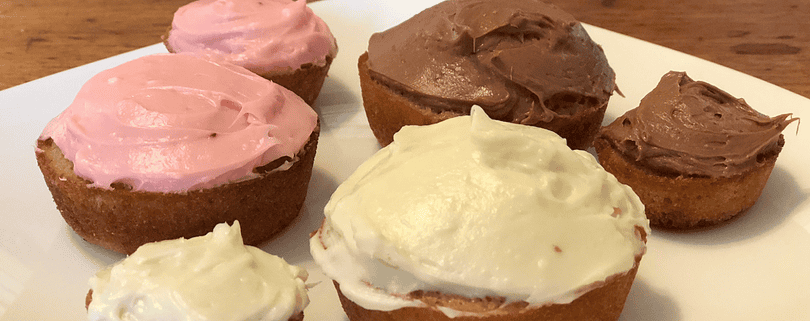
  4. Separate into different bowls to make different flavors. I like to divide mine into thirds and add 1 tablespoon of cocoa powder to make chocolate, a few drops of red food coloring and strawberry extract to make strawberry frosting, and leave one plain vanilla.

    Ophelia Frosting the Cupcakes

    Ophelia Frosting the Cupcakes

  5. Spread the frosting onto the cupcakes once they have fully cooled. You can get fancy by putting the frosting into a little baggie and cutting the tip off to make a cool design or use some frosting tips too.

    Fancy Frosting

    Fancy Frosting

  6. Lightly cover frosted cupcakes with saran wrap and refrigerate.
Frosted Cupcakes

Frosted Cupcakes

In Conclusion

When my kids get a sweet tooth, I’d much rather make something like this from scratch rather than let them have packaged processed food full of many awful and unhealthy ingredients. Yes, they are getting some pure sugar, but they are also getting some really healthy protein and fats as well. Enjoy!

May 5, 2018/by Stacey Maaser
https://embracing-motherhood.com/wp-content/uploads/2018/05/cupcakes.png 400 810 Stacey Maaser https://embracing-motherhood.com/wp-content/uploads/2018/01/EM_Logo.png Stacey Maaser2018-05-05 09:55:162020-11-19 21:05:30Best Cupcake and Frosting Recipe for Kids

Butter is a Superfood!

General, Health, Nutrient Dense Foods
Butter is a Superfood! Embracing Motherhood

I love that as our kids come to HUGE growth spurts, they consume copious amounts of butter. The old me would have cringed at such a thing, but thankfully I’ve read  Nourishing Traditions and discovered Weston Price yet, and I know that butter is a nutrient dense superfood. Here are all of the reasons why butter is a superfood and should be eaten LIBERALLY…especially by growing children and mamas who are pregnant and/or breastfeeding.

Elliot and Ruby Eating Butter

Elliot and Ruby Eating Butter

One stick of butter has 58 grams of saturated fat. This is a good thing! Saturated fats have been demonized by mainstream media, but they are essential for our bodies and especially for growing children. (Read more about why in my blog: The Truth About Fats.)

  • There are certain vitamins that are only soluble in fat, and these include vitamin A, vitamin D, and vitamin K. These fat soluble vitamins occur in LARGE amounts ONLY when the butter comes from cows eating green grass. Vitamins A and D are essential for growth, for healthy bones, for proper development of the brain and nervous system, and for sexual development. The absence of butterfat in growing children results in “nutritional castration” because the male and female sexual characteristics fail to be brought out.
  • The Wulzen Factor also called the “antistiffness factor” is only found in raw animal fat, protects humans from calcification of the joints (degenerative arthritis), hardening of the arteries, cataracts, and calcification of the pineal gland.
  • The Price Factor or Activator X was discovered by Dr. Price and is a powerful catalyst for things like vitamins A and D that help the body absorb and use minerals and can ONLY come from cows eating rapidly growing grass. Dr. Price found that when he gave patients fermented cod liver oil infused with grass-fed butter oil, it practically brought people back from the dead.
  • 12-15% of butter contains short- and medium-chain fatty acids that don’t need to be emulsified by bile salts but can be absorbed directly from the small intestine to the liver where it is converted to quick energy. It also has highly protective lauric acid which is only found in large amounts of coconut oil or small amounts of butterfat.
  • Four carbon butyric acid is unique to butter and has antifungal and antitumor properties.
  • Omega-6 and omega-3 essential fatty acids occur in small but equal amounts in butter.
  • Conjugated linoleic acid (CLA) found in butter has anticancer properties, encourages the buildup of muscle, and prevents weight gain, but only when cows are pasture-fed.
  • The lecithin in butter helps metabolize and assimilate cholesterol and other fats.
  • The cholesterol in butter is needed to produce a variety of steroids that protect against cancer, heart disease, and mental illness.
  • Glycosphingolipids are a type of fat in butter that protects against gastrointestinal infections, especially in the young and elderly. For this reason, children who drink skimmed milk have diarrhea at rates three to five times greater than children who drink whole milk.
  • Trace minerals are incorporated into the fat globule membrane of butterfat including manganese, zinc, chromium, and iodine

Getting butter from grass-fed cows is by far the best. If you have access to raw milk from grass fed cows, the best thing would be to make your own butter or find a local source that sells it. You might be able to find Organic Valley Pasture Butter in season (May-April) at your local grocery store. Kerrygold is imported from Ireland where the cows spend 10 months out of the year on pasture and you can find it online and/or sometimes at your local grocery store. You can also buy organic butter from the store, but it’s expensive and there is no guarantee that the cows were out to pasture.

Sometimes buying healthy food happens in layers and if you’re not to the point of buying expensive butter (I’m not…yet), then know that eating store bought butter isn’t so bad (but you are missing out on some of the amazing health properties). Any hormones or antibiotics that are given to the cows do not get stored in the butterfat, so that’s good at least. Fat soluble poisons such as DDT do accumulate in fats, however. For what it’s worth, we purchase our butter in bulk from Country Life Dairy for $2.75/pound. It is free from rBST bovine growth hormone which makes cows produce an unnatural amount of milk which leads to mastitis, over-use of antibiotics, and a host of other problems. It is actually banned in Canada and European countries.

So now that you know how good butter is, the next question should be: How can I find ways to eat as much butter as possible? My sister recently heard Sally Fallon speak at a conference and she said that vegetables were mostly important because they make excellent vehicles for consuming butter! Personally, I like to lightly steam a head of broccoli, douse it with about a half stick of butter, and then sprinkle it generously with Real Salt. I also like to make organic air popped corn, melt an entire stick of butter to pour over the top, and sprinkle generously with Real Salt for family movie night. Sally Fallon also mentioned that if you are going to have a piece of bread and butter, you should be able to see teeth marks in the butter!

I have started to become creative with how I incorporate butter into our daily lives. I really enjoy my latest idea of melting huge dollops of butter on top of freshly cooked pastured eggs. And even though it is made with sugar, which we all know is the damned devil, I still really enjoy eating cookie dough made with freshly ground grain, two whole sticks of butter, and raw pastured eggs. Mmmmmmm…all this talk about butter is making me hungry! Time for a snack!

For additional reading, check out these articles:

  • Why Butter is Better from the Weston Price website
  • Nutrients in Butter from the Weston Price website
  • Why is Butter Better by Dr. Mercola
January 2, 2018/by Stacey Maaser
https://embracing-motherhood.com/wp-content/uploads/2013/10/butter-is-a-superfood.png 400 810 Stacey Maaser https://embracing-motherhood.com/wp-content/uploads/2018/01/EM_Logo.png Stacey Maaser2018-01-02 02:02:122020-11-19 21:26:37Butter is a Superfood!

How to Make the Best Potato Fries

General, Potatoes, Recipes
Embracing Motherhood How to Make the Best Potato Fries

As a busy mother of four little ones, I love making healthy food that the kids love that fits our budget. These potato fries do all of those things, and this is why I make a big batch of them at least once a week. I try to make enough so that we’ll have extra, but they don’t usually last very long!

Ingredients

  • 6-8 Potatoes (Organic are best, they are one of the dirty dozen!)
  • 2 T. Coconut Oil
  • Real Salt
  • Pepper
  • Optional: Garlic and Onion Powder

Directions

  1. Preheat the Pan: A cast iron skillet would probably be ideal, but for convenience sake, I use a plug in skillet like this. Add coconut oil to the pan and warm it up on a low to medium heat until the oil is nice and hot.
  2. Cut the Potatoes: Wash and cut potatoes. I like to cut mine into strips to make into potato fries, but you could also dice them into little potato cubes or potato circles.

    raw cut up potato fries

    Raw Potatoes Cut Into Fries

  3. Add the Potatoes to the Skillet: When you add the potatoes, the oil should be hot enough to pop.
  4. Cook: Cook with the lid off for about 20-30 minutes on low to medium heat. Flip and stir often. If you leave the skillet uncovered, the fries will be crispier, but take longer to cook. If you cover them, they will cook more quickly, but the fries will be softer.

    potato fries cooking

    Potato Fries Cooking

  5. Season: Add the seasonings of your choice, stir, add a little more, stir, and add a little more. I usually just add a bunch of salt and a dash of pepper.
  6. Serve: My kids like their fries with ketchup of course. For me, I like loading them up like I would a baked potato with cheese, sour cream, and chives. Yum!

    potato fries with ketchup

    Potato Fries with Ketchup

July 3, 2015/by Stacey Maaser
https://embracing-motherhood.com/wp-content/uploads/2015/07/potato-fries.png 400 810 Stacey Maaser https://embracing-motherhood.com/wp-content/uploads/2018/01/EM_Logo.png Stacey Maaser2015-07-03 12:31:552020-11-20 16:16:27How to Make the Best Potato Fries

Homemade Pizza Recipe

General, Pizza, Recipes
Embracing Motherhood Homemade Pizza Recipe

If everyone is hungry and you haven’t made plans for dinner yet, how about a homemade pizza? If you order out, you’re getting freeze dried toppings, loads of “natural flavors” (i.e. MSG), and not to mention you’ll be out $20 or more. By making your pizza at home, you can guarantee that all of your ingredients are fresh, custom designed to the specific needs of your eaters, and at a significant cost savings to boot.

Pizza Crust

  • Sourdough Pizza Crust: If you can plan ahead by about 8 hours or so, this sourdough pizza crust will taste great and be free from the mineral leaching phytic acid present in all grains.
  • Quick and Easy Pizza Crust: If you’re looking for a quick and easy pizza crust that is made with fresh homemade ingredients, this is the recipe for you.

Ingredients

  • Sauce Options:
    • Organic Tomato Sauce: I like finding the little cans that are pre-seasoned with basil and such, but you could use plain tomato sauce and add your own seasonings too.
    • Organic Spaghetti Sauce: I try to keep my cupboards stocked with this and use it if I’m in a pinch.
    • Tomato Pureé: This is  the healthiest option, but it can be a bit watery.
  • Herbs and Spices: Basil, Oregano, Garlic Powder, Onion Powder, and Salt – I like using fresh herbs when I have them, but dried works just as well.) 
  • Mozzarella Cheese (This is the ooey gooey cheese that gives pizza its classic look and taste. You can use just about any cheese and it will taste great though.)
  • Kid Toppings: Pepperoni, Ground Beef, Lunch Meat, Bacon, etc. (My kids really only like meat toppings.)
  • Adult Toppings: Jalapeños, Green Pepper, Onion, Mushrooms, Green or Black Olives, Chives, Tomato, etc.

Directions

  1. Crust: Spread the crust out onto a pizza tray like this or a pizza stone like this. I like using a pizza tray with holes for a nice crispy crust.

    pizza crust

    Pizza Crust

  2. Sauce: If you want to make a pizza that tastes like take out, the trick is to go really really light on the sauce. I prefer it a little thicker though. If I’m using plain tomato sauce, I like to sprinkle some basil, oregano, garlic powder, onion powder, and salt over the sauce. *If I’m feeling really fancy, I like to melt some butter in dish, mix in some herbs and salt, and paint over the outer crust.

    pizza sauce

    Buttered Pizza Crust with Sauce

  3. Season: Add the herbs and spices.